Navigating the complexities of medical coverage during unpaid Family and Medical Leave Act (FMLA) leave can be challenging for both employees and employers. One common question that arises is whether employees can prepay their share of medical plan coverage on a pre-tax basis. The answer is yes, but it depends on the specifics of your cafeteria plan.
Prepayment Option Under FMLA
The IRS FMLA regulations permit three payment options for employees wishing to pay their share of the premiums for group health coverage during an unpaid FMLA leave. These options are prepay, pay-as-you-go, and catch-up.
Prepay allows employees to pay the contributions due during the leave before the leave commences. This option cannot be the sole option offered to employees on FMLA leave, although it may be restricted to employees on FMLA leave.
Pay-as-you-go enables the employee to pay his or her share of the cost of coverage during the leave.
Catch-up involves the employer advancing payment of the employee’s share during leave, and the employee repays the employer upon return.
Your cafeteria plan may provide one or more of these payment options, as long as the options for employees on FMLA leave are offered on terms at least as favorable as those offered to employees not on FMLA leave.
How Does Prepayment Work?
Under the prepay option, employees are given the opportunity to pay, before starting FMLA leave, the contributions that will be due during the leave period. They can voluntarily elect to reduce their final pre-leave paychecks or make special salary reduction contributions to cover their share of the premiums for all or part of the expected duration of the leave. Prepay contributions could also be made on an after-tax basis.
During the leaves, your company would pay its share of the premium in the same manner as before. When an employee’s leave ends, the employee’s previous salary reduction election would resume for the rest of the plan year unless the employee makes a change in election permitted under IRS regulations upon return from leave.
Limitations of Prepayment
If an employee’s leave straddles two plan years, only the contributions for coverage during the first plan year can be prepaid on a pre-tax basis. This is due to the cafeteria plan “no-deferred-compensation” rule that generally prohibits the use of one year’s contributions to fund benefits in a subsequent year. However, a cafeteria plan with a grace period under its premium payment component could arguably allow employees taking an FMLA leave that straddles two plan years to make pre-tax prepayments for up to 2-1/2 months of coverage during the second plan year before the leave begins.
Conclusion
Understanding the options for medical coverage during unpaid FMLA leave is crucial for both employees and employers. While prepayment is a viable option, it’s essential to consider the specifics of your cafeteria plan and the IRS regulations to ensure compliance.
When an employee passes away, employers often face challenging questions regarding benefits and compensation. A common question that arises is whether an employer can pay a deceased employee’s unused Health Reimbursement Arrangement (HRA) balance to the surviving spouse. This article delves into the regulations and best practices surrounding HRAs in such scenarios, ensuring compliance and clarity.
HRAs and Their Restrictions
Health Reimbursement Arrangements (HRAs) are designed to reimburse employees for qualifying medical expenses, as outlined in Code § 213(d). Importantly, HRAs are not allowed to disburse cash payments to employees or their beneficiaries at any time, including after the employee’s death. Any attempt to convert HRA balances into cash would disqualify the HRA for all participants, rendering all reimbursed amounts taxable—even those for legitimate medical expenses.
The Concept of Post-Death Spend-Downs
While direct cash payments are prohibited, HRAs can include a provision known as a post-death “spend-down.” This feature allows the remaining HRA balance to be used to cover qualifying medical expenses for the deceased employee’s surviving spouse, tax dependents, and qualifying children. Employers should check their HRA plan documents to see if this feature is included and, if not, consider amending the plan to incorporate it.
Compliance and Nondiscrimination Rules
Amending an HRA plan to include a post-death spend-down feature must comply with several nondiscrimination rules. These rules ensure that benefits are not skewed in favor of highly compensated individuals. Specifically, all benefits provided to highly compensated participants must also be made available to all other participants.
Additionally, IRS Notice 2015-87 casts some uncertainty on whether family members without major medical coverage can utilize a post-death spend-down feature. Until further clarification from the IRS, a cautious approach would be to limit these reimbursements to family members who also have major medical coverage.
Administering Post-Death Spend-Downs
Proper administration of the post-death spend-down feature is crucial. Only qualifying medical expenses for eligible individuals should be reimbursed. Failure to adhere to this can result in all HRA reimbursements becoming taxable, not just those for ineligible expenses. Employers must also remember their obligations under COBRA. If a deceased employee’s death triggers a COBRA qualifying event, then qualified beneficiaries must be given the opportunity to continue their HRA coverage for the duration prescribed by COBRA, regardless of the presence of a post-death spend-down feature.
Conclusion
While it may seem compassionate to pay out a deceased employee’s unused HRA balance to their surviving spouse, doing so would jeopardize the tax-advantaged status of the HRA for all participants. Instead, employers should explore the option of a post-death spend-down feature, ensuring they comply with all relevant nondiscrimination rules and administrative guidelines. By carefully navigating these regulations, employers can support their employees’ families while maintaining the integrity of their HRA plans.
The Consolidated Omnibus Budget Reconciliation Act (COBRA) provides employees with the option to continue health insurance coverage after leaving their job. However, certain circumstances, such as gross misconduct, can affect the availability of this coverage. This blog post explores a unique case where an employee’s gross misconduct was discovered after retirement and the implications for COBRA coverage.
The Case
Three months ago, a bookkeeper retired from a company, electing COBRA coverage under the company’s medical plan. Recently, it was discovered that she had embezzled thousands of dollars during her tenure. The question arose: Could the company retroactively terminate her COBRA coverage due to this gross misconduct?
The Verdict
The short answer is probably not. While COBRA coverage need not be offered to employees terminated due to gross misconduct, in this case, the bookkeeper voluntarily retired and elected COBRA before her misconduct was discovered.
The Legal Perspective
If an employee is terminated for gross misconduct, there is no COBRA qualifying event for the employee or any covered dependents. However, employers should exercise caution when denying COBRA coverage due to gross misconduct. This is because COBRA does not clearly define “gross misconduct,” and courts have not agreed on a common standard. Therefore, denying COBRA coverage due to gross misconduct carries a higher-than-usual risk of litigation.
The After-Acquired Evidence
In this case, the company faces an additional obstacle. While embezzlement likely constitutes gross misconduct for COBRA purposes, the employee’s termination was due to voluntary retirement, not gross misconduct. Courts generally evaluate an employer’s decision to deny COBRA based on evidence available at the time of the employee’s discharge. The use of after-acquired evidence of gross misconduct to justify termination of employment has been rejected by the U.S. Supreme Court and several other courts in the COBRA context. Therefore, it is unlikely that a court would allow COBRA coverage to be terminated—retroactively or going forward—when gross misconduct is discovered after an employee has elected COBRA.
Conclusion
This case serves as a reminder for employers to consult with legal counsel and insurers when considering the denial of COBRA coverage due to gross misconduct. It also highlights the complexities involved in COBRA coverage termination, especially when evidence of misconduct is discovered post-employment. As always, each case is unique and should be evaluated on its own merits.
Understanding cafeteria plan election changes can be complex, especially when dealing with domestic partner relationships. Here’s what you need to know about whether such relationships qualify for election changes under cafeteria plan rules.
Domestic Partner Relationship and Election Changes
The commencement of a domestic partner relationship does not qualify as a “change in marital status” under cafeteria plan rules. Legal marital status changes include marriage, death of a spouse, divorce, legal separation, and annulment. While the list is not exhaustive, the IRS does not recognize the start or end of a domestic partner relationship as equivalent to these events.
Alternative Election Change Event: Change in Coverage Under Another Employer Plan
However, another permitted event, “change in coverage under another employer plan,” may allow for an election change. If your plan includes this provision, your employee can drop major medical coverage upon becoming covered under their partner’s employer plan. This event does not restrict changes to the plans maintained by the employer of a spouse or dependent but does not allow changes to health FSA elections.
Key Takeaways
Domestic Partner Relationship: Does not qualify as a change in marital status for election changes.
Change in Coverage: Employees can change their election if covered under a partner’s employer plan.
Documentation: Required to prove new coverage under the partner’s employer plan.
Plan Specifics: Check your specific cafeteria plan terms for detailed rules and procedures.
Conclusion
While domestic partner relationships don’t qualify for election changes under marital status rules, a change in coverage under another employer plan can allow adjustments. Always consult your cafeteria plan specifics and seek professional advice for compliance.
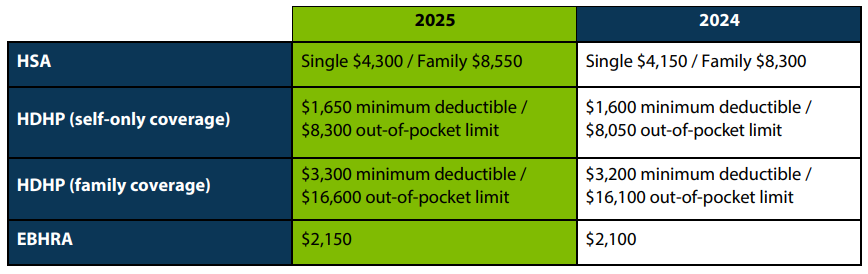
The IRS recently announced the 2025 limits for Health Savings Accounts (HSAs) and High Deductible Health Plans (HDHPs). HSA contribution and plan limits will increase to $4,300 for individual coverage and $8,550 for family coverage. Changes to these limits will take effect January 2025.
HSAs are tax-exempt accounts that help people save money for eligible medical expenses. To qualify for an HSA, the policyholder must be enrolled in an HSA-qualified high-deductible health plan, must not be covered by other non-HDHP health insurance or Medicare, and cannot be claimed as a dependent on a tax return.